 Ecopack
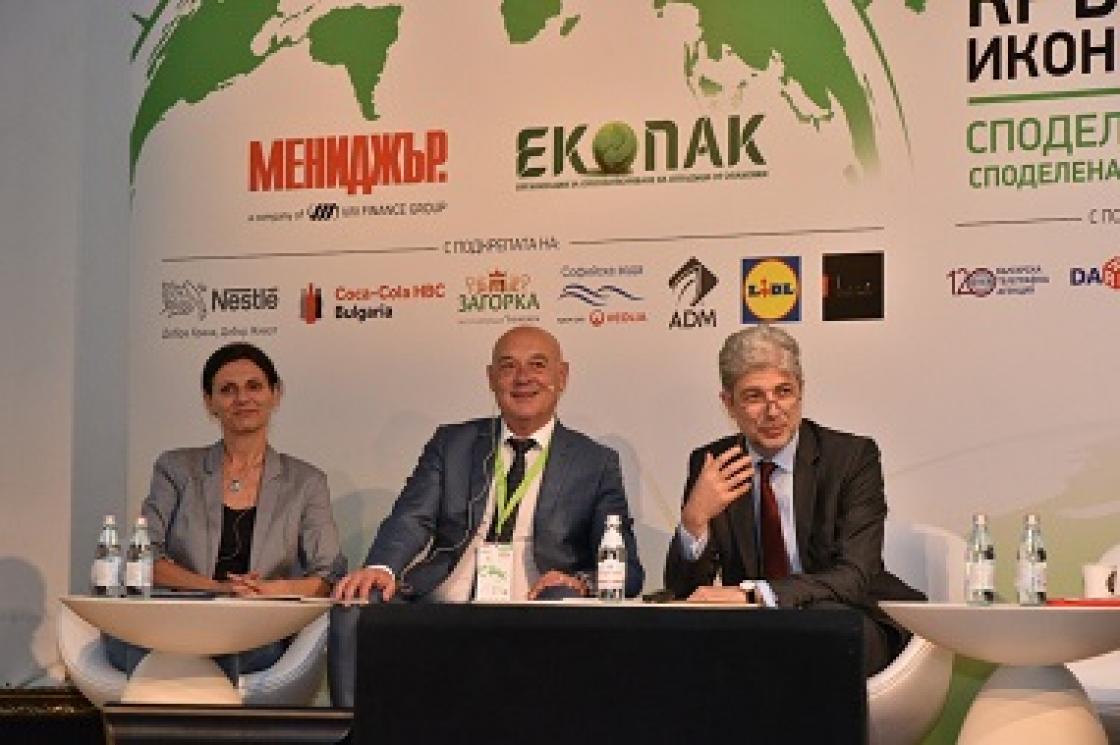


The Circular Economy is a completely new concept of life that we must adopt. It will be part of the new model of the so-called Waste Hierarchy, announced Minister of Environment and Water Neno Dimov, who opened the Ninth National Green Forum of Manager Magazine and ECOPACK Bulgaria at the Sofia City Mark Art Center yesterday, 19.06.2018.
Topmost in the hierarchy of the circular economy is waste prevention - that is, tomake the product in such a way that it does not generate waste. This is the most ambitious goal of the circular economy, Minister Dimov explained.
The second most important task will be to extend product lifeand minimize landfillwaste. The EU target will be to reduce landfill waste to 10% in each country.
The third level in waste hierarchy is the development,through the so-called ecodesign,of products that are easilyand fully recyclable.
Ecodesign requirements will have to be enforced by 2022 at the latest,and in Bulgaria we will try to introduce themeven sooner- so that products will be made in a way as tomeet the hierarchical structure of the possibilities of the circular economy, Minister Dimov added.
Sofia Municipality is close to meeting the European target for bringinglandfill waste downto 10%, said Joana Hristova, Deputy Mayor of Sofia MunicipalityforGreen System, Ecology and Land Use. Total landfillwaste has been reduced to 16%, and with new projects and campaigns,some of which have already started, she was convinced this percentage woulddropbelow 10. Sofia Municipality is also the first to introduce a mobile waste collection system, Deputy Mayor Hristova announced,and expressed her wishfor the day to come when the capital does not have asingleton of waste destined for landfill.
The challenges for everyone in terms of the introduction of the circular economy are also opportunities that will createnew jobs and generate investments. This was pointed outby Todor Bourgoudjiev, Executive Director of the largest organization for separate collection of packaging waste,ECOPACK Bulgaria. He further noted that, according to the new requirements of the EU's circulareconomy package, from 22.5% at present, plastic waste collection targets will go up dramatically to as much as 75% in 2030.
Onecompletely new targetthat has been set is the separate collection and handing overfor recycling of aluminum. Now, however, we urgently need to reactwith respect toplastic, because about 20% of the total plastic production in the world is used for packaging and the world's largest producer is China, Bourgoudjiev noted.
In this respect, ECOPACK has already planned several urgentmeasures to increase the waste collection containers in cities by 25% overthe next few years. In addition, a paper and plastic collection project will be implemented in Sofia's commercial outlets,andplasticwaste collection systems will be set upin public buildings and institutions, including schools and kindergartens.
What was confirmed at the 9th National Green Forum of Manager Magazine and ECOPACK Bulgaria, is that business is one of the main vehiclesof the transition to a circular economy, realizes itsresponsibility and is already working on new, even higher goals to meet its requirements.
As the number one food and beveragecompany in the world, it is especially important for us to be involved in everything that is vitalto the future of the world and of the environment, said one of the main participants,Emmanuel Artur, Executive Director of Nestle Bulgaria.It is a major commitment of the company for its production activity to have zero environmental impact and this is being implemented through three priorities: taking into account climate change, water resource protection, and ongoing waste reduction efforts, he said. Over the past few years, we have cut our gas emissions by more than 33%, more than half of our factories worldwide do not send any waste to landfill and one of those is the factory in Bulgaria," said Emmanuel Artur. Over the past 30 years Nestlé has reduced finished product packaging by more than 18,000 tons, which is equivalent to taking 84,000 vehicles off the roads forever. A new commitment of the company is to recycle or reuse all packaging of the company's products by 2025. At present, only 40% of the company's packaging is new, i.e. 60% is recyclable and reusable, he added.